








How to choose the right flange for your piping system
A flange looks like a simple steel ring until you try to order one. Then the questions start: weld neck or slip on? Raised face or flat? Class 150 or Class 300? The wrong pick wastes money at best and leaks at worst. This article breaks the decision into the few choices that actually matter, the way a flange manufacturer would walk a customer through them.
Pick the flange type by how it joins the pipe
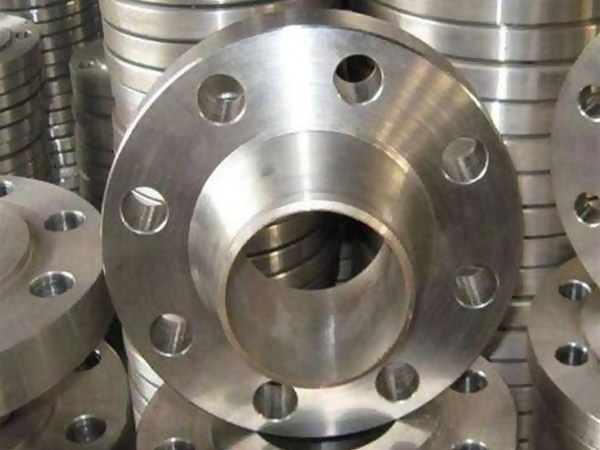
Weld neck flanges have a long tapered hub that is butt welded to the pipe. The hub transfers stress into the pipe wall instead of concentrating it at the weld, which is why process plants specify weld neck for high pressure, cyclic loads and hazardous media. Slip on flanges slide over the pipe and take two fillet welds, one at the hub and one inside. They cost less and are easier to align, so they are common on low pressure utility lines where the extra fatigue strength is not needed.
Blind flanges close the end of a line or a nozzle, and they are useful because a line can be reopened later without cutting. Lap joint flanges work with stub ends: the flange itself is loose, so it rotates and lines up bolt holes quickly. That combination suits alloy or stainless lines where a cheap carbon steel backing flange saves money. Threaded flanges screw onto a threaded pipe end with no welding at all, which suits repair work in areas where hot work is banned.
Pick the pressure class by the real operating conditions
ASME B16.5 covers flanges from NPS 1/2 through NPS 24 in pressure classes 150, 300, 400, 600, 900, 1500 and 2500. The class number is not a pressure rating in bar or psi. It is a group of dimensions whose allowable pressure changes with temperature and material. A Class 150 carbon steel flange is good for roughly 14 bar at ambient temperature, but only about half that at 400 degrees Celsius. A Class 300 flange of the same material carries close to 35 bar cold.
The practical method is to take your design pressure and temperature, find them in the B16.5 pressure temperature table for your material group, and pick the lowest class that covers the pair with margin. Going two classes up for a small line adds weight and bolt torque for no benefit. For projects outside the B16.5 size range, B16.47 Series A and B cover large diameter flanges from NPS 26 through NPS 60, with Series A heavier and Series B matching the dimensions used by most European fabricators.
Pick the facing and its surface finish
The sealing surface is where flanges earn their keep. A raised face, the default for Class 150 through 2500, mates with a compressed gasket on a ring of steel standing about 2 mm proud of the bolting surface. Flat faces suit brittle materials such as cast iron and some plastic flanges, because a raised face would bend the mating part when the bolts tighten. Ring type joint facings hold a machined metal ring in a groove, and they seal reliably at high pressures and temperatures where soft gaskets creep or burn.
Surface finish matters as much as the facing type. B16.5 defines a serrated finish of 3.2 to 12.5 micrometers roughness, produced by a spiral or concentric tool path. A stock finish works with compressed sheet gaskets, while a smoother finish is often specified for spiral wound gaskets with graphite fill. Ask the flange supplier how the face is machined, because a facing cut on a vertical lathe with the right feed rate seals better than one that was rushed.
Check material, drilling and the paperwork
Forged carbon steel flanges for general service are usually ASTM A105, with A350 LF2 for low temperature and A182 grades for stainless and alloy. Match the flange material to the pipe specification, or the gasket joint becomes the weak link through galvanic effects or different expansion rates. Drilling must match the valve or equipment on the other side of the joint, so confirm the standard, ASME, DIN, JIS or table letter, before the workshop cuts the bolt holes.
Reputable flange manufacturers stamp each piece with heat number, material grade and class, and can supply EN 10204 3.1 certificates on request. For projects with third party inspection, ask the factory to present the forging record and the certificate side by side so the inspector can close the check in one sitting. That habit prevents the most common problem in flange purchasing, which is paperwork that does not quite match the steel.
References
ASME B16.5, Pipe Flanges and Flanged Fittings NPS 1/2 Through NPS 24 Metric/Inch Standard, American Society of Mechanical Engineers, New York, 2017 edition.
ASME B16.47, Large Diameter Steel Flanges NPS 26 Through NPS 60, American Society of Mechanical Engineers, New York.
ASTM A105/A105M, Standard Specification for Carbon Steel Forgings for Piping Applications, ASTM International, West Conshohocken, PA.
Charles Becht IV, Process Piping: The Complete Guide to ASME B31.3, 3rd edition, ASME Press, New York, 2016.