








How pipe fittings are made: from steel plate to finished elbow
Buyers see pipe fittings as line items on a drawing, but every elbow and tee starts as raw steel that someone has to form, weld, heat treat and machine. The forming route a manufacturer chooses shapes the fitting's wall uniformity, its grain flow and its final price. Knowing the main routes helps you ask better questions at a factory audit and read quotations with more insight. Here is what actually happens inside a pipe fittings plant.
Pressing elbows from plate
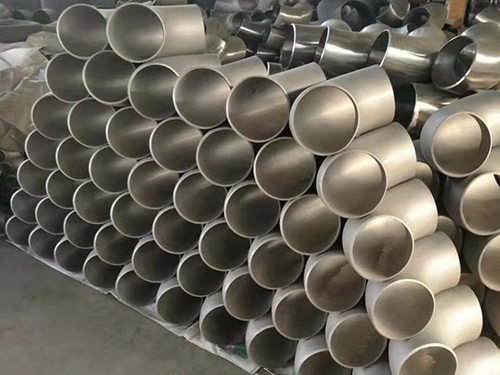
The classic route for medium and large elbows starts with steel plate. Blanks are cut to a developed shape, pressed in matched dies into two half shells, then welded along the two seams to form the complete bend. After welding, the ends are squared and beveled. Pressed elbows suit large diameters and heavy walls, and the tooling cost is moderate because one press serves many sizes with die changes.
The seam welds are the quality focus of this route. Each weld receives full penetration, is dressed flush, and on critical work is radiographed or ultrasonically tested. A manufacturer with its own pressing lines and welding stations controls the heat input and the fit up directly, which is why seam weld quality tends to be consistent from factories that press in house rather than buy shells from elsewhere.
Pushing elbows from pipe
The push method, sometimes called hot push or mandrel bending, feeds a pipe section over a shaped core rod. The pipe passes through an induction coil that heats a narrow band to forming temperature, and a hydraulic ram pushes the softened section over the mandrel, stretching it into the elbow curve. Long radius 90 and 45 degree elbows come off the same setup, and larger radius bends for pigging lines use the same principle with longer tooling.
Pushing has a quiet advantage: the wall stays remarkably uniform because the deformation is spread around the whole heated band rather than concentrated at the outer radius. That is why hydraulic systems, high pressure fuel lines and critical process piping favor pushed elbows. The process also produces no seams, so inspection is simpler and the fitting behaves like the parent pipe.
Forging tees and machining faces
Standard tees are often made as forged or hot extruded blanks. In hydraulic bulging, a pipe blank is loaded into a die and internal pressure pushes a branch outward through an opening, forming a seamless tee body in one operation. Alternative routes weld a branch pipe onto a formed opening, which is common for large reducing tees where solid tooling would be uneconomic. Both routes end the same way: the three ends are squared, machined and beveled to the ASME B16.9 center to face dimensions.
Flanges follow the forging path. Billets are heated, stamped or ring rolled into rough shapes, normalized, then machined to the B16.5 dimensions with the facing cut last. A direct reading spectrometer verifies chemistry on each heat before the pieces are stamped, so the grade markings on the finished flange trace back to a real melt record.
Heat treatment and final checks
Hot formed fittings do not leave the furnace work behind at the forming stage. Carbon steel shapes are normalized to refine the grain distorted by hot working, and alloy grades receive quench and temper or normalize and temper schedules that develop the strength the specification promises. Heat treatment is recorded in charts, and critical buyers ask to see the furnace log along with the mechanical test results.
Final inspection covers dimensions, bevel angle and surface condition, plus non destructive testing where the order calls for it. Ultrasonic checks find laminations in heavy wall fittings, magnetic particle testing finds surface cracks on carbon and alloy shapes, and dye penetrant serves the same purpose on stainless. Hydro or proof pressure testing closes out high pressure orders. Factories that maintain these facilities in house can answer an inspector's questions the same day rather than in the next shipment.
Reducers and caps follow simpler routes. Reducers are pressed in dies that draw one end down toward the other, concentric or eccentric, while caps are deep drawn or spun from plate. Neither carries a seam in most sizes, which keeps their inspection short and their scrap rate low.
None of these routes is secret, but the difference between a rushed job and a careful one shows up years later in the pipeline. When a supplier can tell you how your fitting was formed, which furnace treated it and which heat number it carries, you are holding more than a piece of steel, you are holding its biography.
References
ASME B16.9, Factory-Made Wrought Buttwelding Fittings, American Society of Mechanical Engineers, New York, 2018 edition.
ASTM A234/A234M, Standard Specification for Piping Fittings of Wrought Carbon Steel and Alloy Steel for Moderate and High Temperature Service, ASTM International, West Conshohocken, PA.
ASM International, Forming and Forging, Metals Handbook Volume 14, ASM International, Materials Park, OH.
Mohinder L. Nayyar, Piping Handbook, 7th edition, McGraw-Hill, New York, 2000.