








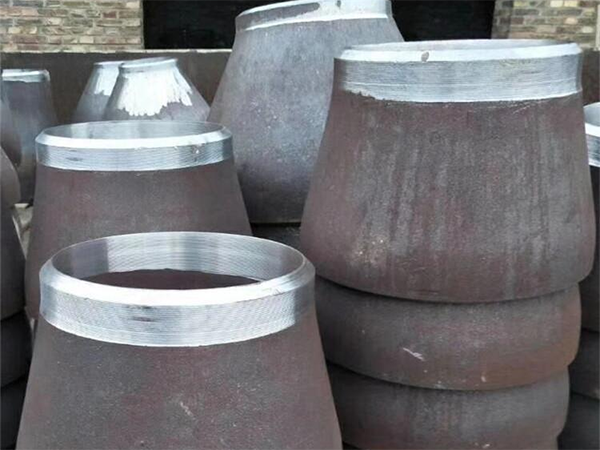
1、 Core Definition and Function
A reducer, commonly known as a big or small head, is a one-to-one fitting used to connect two pipes of different nominal diameters. Its core function is to achieve a smooth transition of the flow cross-section of the pipeline system at different positions, thereby changing the flow rate or velocity.
As a "variable diameter hub" in pipeline systems, reducers can effectively reduce turbulence, eddies, and pressure losses caused by sudden changes in pipeline size through their conical structure, protecting the stability of fluid transport and system energy efficiency.
2、 Main types and structural characteristics
Reducing pipes are mainly classified based on whether their geometric centerlines are offset, and different structures are suitable for different installation requirements.
1. Concentric reducer
This is a commonly used type. Its characteristic is that the centers of the two ports are located on the same axis, and the overall shape is a conical frustum. When the fluid passes through, the medium uniformly contracts or expands at the center of the pipeline without generating additional radial bias. Mainly used for vertical pipelines that require strict consistency in fluid direction or horizontal pipelines with no special requirements for convection.
2. Eccentric reducer
Its characteristic is that the center of one port deviates from the center of the other end, forming an overall oblique truncated cone shape. According to the eccentricity method, it can be divided into:
Bottom eccentricity: The bottom tangent lines of the large and small ports are kept on the same horizontal plane. This is a common form of eccentricity, mainly used for horizontally installed gas or liquid pipelines, which can achieve a flat bottom of the pipeline, prevent liquid accumulation, and protect the complete emptying of the fluid.
Top eccentricity: The top tangent lines of the large and small ports are kept flush. Commonly used to adjust the top elevation of pipelines or for installation under specific spatial constraints.
Eccentricity is a key technique in process pipeline layout, used to solve practical problems such as fluid accumulation, alignment, or spatial constraints.
3、 Core process
The process of reducing pipes directly affects their performance, cost, and application range.
1. Seamless compression reducer
The steel billet made of the same material as the pipe is heated and then hot pressed once by hydraulic press and one-to-one mold. Its characteristics are no welds, uniform wall thickness, good streamline, and excellent pressure resistance. This is a trustworthy merchant process for high-pressure applications, especially suitable for small caliber or demanding situations.
2. Welding to make reducing pipes
There are mainly two ways:
Rolling and welding of steel plates: Cut fan-shaped plates from steel plates, weld them into cones after rolling, and then assemble and weld them with the interface pipe sections at both ends. Suitable for large-diameter and thin-walled reducers, with relatively low cost and good flexibility.
Pipe cutting, strip drawing and welding: Cut multiple triangular notches evenly on one end of a large-diameter pipe, heat it up, close the cutting edge and weld it to form a small opening. This method is now less commonly used.
3. Casting reducing pipes
Mainly used for special materials (such as cast iron, certain alloys) or situations with complex shapes and large wall thicknesses. The inner surface smoothness and dimensional accuracy are usually lower than those of the pressed parts, and machining is required to meet the usage requirements.
4、 Key connection methods
The reducer is connected to the pipeline system through its interface at both ends:
Butt welding connection: The two ends of the reducing pipe are machined with standard grooves, which are directly butt welded with pipes of different diameters. This is a quality and pressure resistant connection method used in industrial pressure pipeline systems.
Socket welding/threaded connection: used for small-diameter (usually DN ≤ 50), low-pressure applications, such as instrument pipes, auxiliary pipelines, etc., for easy installation and disassembly.
Flange connection: The two ends of the reducer are equipped with flanges, which are connected to the matching flanges through bolt groups. Convenient for segmented prefabrication and later maintenance and repair of the system.
5、 Materials and Execution Standards
The material of the reducer should match the entire connected pipeline system, and common materials include:
Carbon steel: 20 #, Q235, A234 WPB, etc., used for general media.
Stainless steel: 304, 316L, etc., used in corrosive environments or clean systems.
Alloy steel: P11, P22, P91, etc., used in high-temperature and high-pressure applications.
Other materials: plastics (PP, PVC), non-ferrous metals, etc.
Its inspection follows standards such as China's GB/T 12459 (Steel Butt Welded Seamless Pipe fittings), GB/T 13401 (Steel Plate Butt Welded Pipe fittings), and the widely recognized ASME B16.9.
6、 Core application industry
Reducing pipes are essential components for achieving flexible pipeline systems in process industries and public engineering
Petrochemical and refining: Connecting process pipelines of different diameters, such as variable diameter at the inlet and outlet of pumps and before and after regulating valves.
Power industry: In the steam and water pipelines of power plants, interfaces are used to connect equipment of different pressure levels.
Municipal water supply and drainage: connection between main and branch pipes, inlet and outlet of water treatment structures.
HVAC: Connection between the main and branch pipes of the air conditioning water system, and variable diameter treatment of the air ducts.
Ship and Ocean Engineering: Layout and Connection of Fluid Piping Systems in Complex Cabins.