








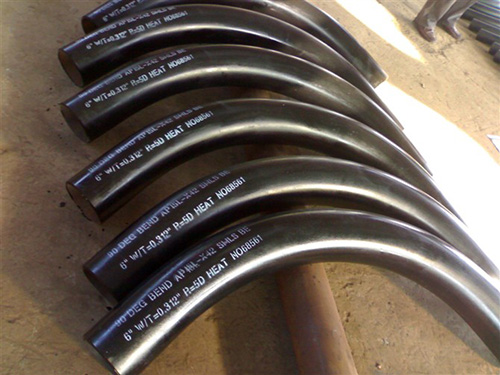
1、 Core Definition and Function
Bending pipe refers to the use of bending equipment and technology to directly bend straight pipe sections into the required angle and curvature of fittings or pipe sections. The core difference between it and the "elbow" is that the elbow is a continuous body processed from standard straight pipes, while the elbow is an independent, pre made pipe fitting.
Its core functions are:
Realize continuous turning: change the spatial direction of the pipeline with smooth transition curves, connecting two pipelines in different directions.
Optimizing fluid performance: Due to the large and continuous curvature radius of bent pipes, turbulence, pressure loss, and erosion wear on the pipe wall can be greatly reduced, especially for high-speed fluids.
Adapt to complex layouts: capable of flexible and multi planar bending in three-dimensional space, meeting compact or special equipment layout requirements.
Reduce connection points: As a continuous pipe, it reduces the number of welds or connection points in the pipeline system, thereby reducing the risk of leakage and installation costs.
2、 Main types and characteristics
Bending pipes are mainly classified based on their process, bending radius, and spatial form.
1. Classified by process
Cold bending pipe: Plastic bending of pipes is performed using a pipe bending machine at room temperature. Suitable for pipes with medium and small diameters (usually below DN200) and good plasticity, such as carbon steel, stainless steel, copper pipes, etc. After cold bending, the pipe wall may become slightly thinner, the outer side may stretch slightly, and the inner side may wrinkle, so there are lower requirements for wall thickness and bending radius. Its advantages are good efficiency, low cost, and surface area.
Hot bend pipe: Before bending, heat the area of the pipe to be bent locally or as a whole (usually above the recrystallization temperature of the material), and then bend it. Suitable for materials such as large-diameter, thick walled pipes or alloy steel that are difficult to cold bend. Hot bending can reduce rebound, achieve a small bending radius, and maintain uniform wall thickness. But the process is complex, the cost is high, and it may affect the metallographic structure of the material.
Core rod bending: During cold bending, a specific shaped core rod (mostly ball joint type) is inserted into the tube cavity to support the tube wall, effectively preventing serious wrinkles and excessive elliptical deformation of the cross-section on the inner side during bending. It is a key process for obtaining a more accurate and suitable bending tube.
Coreless bend pipe: does not rely on internal core rods, only relies on external molds for bending. Suitable for situations with thin walls, low requirements for internal smoothness, or large bending radii.
2. Classify by bending radius
Large radius bend: Its curvature radius is much larger than a multiple of the pipe diameter (such as 5D, 8D, or even larger). The bends are smooth and the fluid resistance is low. It is commonly used for transporting slurry, granular materials, or pipelines with strict pressure drop requirements (such as power plant main steam pipelines).
Standard radius bend: The bending radius is about 3 to 5 times the diameter of the pipeline, which is a common balance choice in engineering, taking into account both flow performance and spatial layout.
Compact bend: The bending radius is close to or equal to 1.5 times the diameter of the pipe. Used in situations where space height is limited, but flow resistance and wear will significantly increase.
3. Classify by spatial form
Two dimensional curved pipe: All bends are completed in the same plane, such as a simple "L" or "U" shape.
3D space bending: Bending is carried out in multiple planes to form complex spatial curves, such as "S" shapes or circuitous pipelines that bypass other equipment. This has high control and process requirements for the pipe bending machine.
3、 Key processes and technical elements
The quality of bent pipes depends on meticulous process control:
Wall thickness variation control: During bending, the outer tube wall may become thinner under tension, while the inner tube wall may become thicker or wrinkled under compression. The wall thickness reduction rate of the bent pipe is required to be controlled within the Enron standard.
Ellipticity control: Circular sections may become elliptical after bending. Elliptical crossing can affect the flow area, structural strength, and subsequent connections. The process needs to confirm that the ellipticity does not exceed the standard.
Rebound control: The material will have a slight rebound angle after bending and unloading. A good quality pipe bending machine uses angle compensation function to pre bend during programming to accurately achieve the target angle.
Surface quality and protection: The bending process should not cause scratches, indentations, or oxidation on the inner and outer surfaces of the pipe. For stainless steel or coated pipes, it is necessary to use molds and protective measures.
4、 Materials and Execution Standards
The material of the bent pipe is consistent with the pipeline system, including but not limited to:
Carbon steel: A106 Gr. B, API 5L, etc., used for general industrial pipelines.
Stainless steel: 304, 316, duplex steel, etc., used in corrosive or clean environments.
Alloy steel: P91, P22, etc., used for high-temperature and high-pressure power plant pipelines.
Nonferrous metals: copper, aluminum, titanium, nickel based alloys, etc., used in special industries.
Its acceptance follows standards such as ASME B16.49 (factory made steel butt welded bends), GB/T 30862 (induction heating bends for industrial pipelines), etc. The standards have strict regulations on bending radius, dimensional tolerances, wall thickness reduction rate, ellipticity, etc.
5、 Core application industry
Bent pipes are used in industries that require high pipeline quality due to their excellent fluid performance and layout flexibility
Power industry: The main steam pipelines and high-pressure feedwater pipelines of nuclear power plants and thermal power plants commonly use large radius hot bending pipes to withstand high pressure and temperature cycles.
Petroleum natural growth gas: directional changes in long-distance pipelines, complex process pipelines on offshore platforms, and hot and high-pressure pipelines in refining facilities.
Chemical and shipbuilding: alloy material pipelines in chemical plants, engine exhaust pipes in ships, and complex cabin pipelines.
Aerospace: Fuel and hydraulic pipelines for aircraft engines require high weight to weight ratios and performance.
Equipment: Transport pipelines for high-purity media in semiconductor equipment and pharmaceutical machinery.