








Flange gasket selection: matching the gasket to the joint
Bolted flange joints do not seal on their own. The gasket does the sealing, and the flange, the bolts and the surface finish only create the conditions the gasket needs. When a joint leaks, the reason is usually a gasket chosen by habit rather than by service conditions: a soft sheet gasket asked to survive 500 degrees, or a metal ring crushed onto a face cut for something else. This guide matches the common gasket families to the joints they belong in, the way a flange manufacturer approaches a sealing question.
Soft cut gaskets: the everyday workhorse
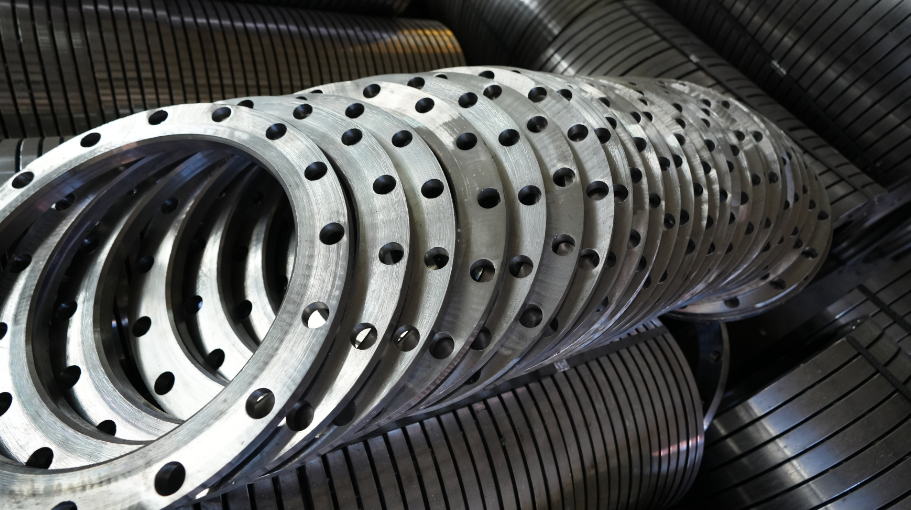
Compressed fibre sheet, aramid or graphite based, cut into full face or ring shapes, seals the vast majority of low and medium pressure joints. Sheet gaskets conform to imperfect faces, cost little and install with ordinary torque practice. Their limit is a moving target of temperature and chemical resistance: standard grades serve up to about 200 to 300 degrees depending on formulation, and graphite sheet extends this toward 450 and beyond at low pressure.
PTFE based gaskets cover the chemical duty that fibre cannot, acids, chlorides and solvents, and filled PTFE grades handle the creep problem that limited older virgin PTFE, which cold flowed and relaxed under bolt load. Soft gaskets suit raised face and flat face joints, and the choice between ring style, sitting inside the bolt circle, and full face, covering the whole flange with bolt holes, follows the flange facing: flat faces on cast equipment take full face gaskets, standard raised faces take rings.
Spiral wound: the engineer's middle ground
A spiral wound gasket is a wound ribbon of metal and soft filler, V shaped metal windings alternating with graphite or PTFE filler, usually held by an outer metal centering ring and an inner ring for high classes. Under bolt load the metal windings act as springs, maintaining gasket stress through thermal cycles, while the filler seals the minor imperfections of the flange face. The result is a gasket that handles pressure and temperature combinations far beyond soft sheet, from steam to hydrocarbons to cryogenic service with the right filler and winding metal.
Spiral wound gaskets demand a seating stress to work, which is why they perform on Class 300 and above, or on Class 150 flanges in the larger sizes where bolt load is adequate. Undersized flanges or lightly bolted joints are the classic failure case: the gasket never seats and relaxes slowly until it weeps. The centering ring keeps the winding centered in the bolt pattern, and the inner ring protects the winding from blowout and from erosion in aggressive flow. Match the winding and filler materials to the fluid, 316 windings with graphite filler is the common default.
Ring type joint: metal on metal
For the severe end, the ring type joint gasket seals in the groove of an RTJ flange facing. The soft iron, low carbon steel or stainless ring yields into the groove flanks under bolt load, and the seal survives pressures and temperatures that destroy organic materials. RTJ rings come in oval and octagonal cross sections, R and RX pressure energized styles, and BX styles for high pressure wellhead equipment. Rings are replaced after every opening, because a yielded ring will not reseat.
The facing, groove dimensions and ring style must all follow ASME B16.20 together, and the groove surface finish is part of the seal. A scratched groove or a ring of the wrong number is a joint that will not seal no matter how the bolts are tensioned, so the flange supplier and the gasket source need to agree on the standard, which the purchase order should settle in one line.
Choosing and installing: the practical rules
Start from three conditions: design pressure, design temperature and the fluid. Pick the gasket family that all three tolerate with margin, then verify the flange facing and bolt load can deliver the seating stress that family requires. Check the chemical resistance of the filler against the fluid, and remember that flange surface finish must match the gasket: serrated finishes for soft and spiral wound, smooth grooves for RTJ.
Installation completes the system. Tighten in a star pattern in stages, never in a single pass, and use calibrated wrenches or tensioning equipment on larger joints. Retorque once after thermal cycling where the specification allows it. A joint assembled this way, with the gasket chosen by service rather than by habit, holds for years without attention, which is the quiet definition of a flange joint done right.
References
ASME B16.20, Metallic Gaskets for Pipe Flanges: Ring-Joint, Spiral-Wound, and Jacketed, American Society of Mechanical Engineers, New York.
ASME B16.21, Nonmetallic Flat Gaskets for Pipe Flanges, American Society of Mechanical Engineers, New York.
ASME B16.5, Pipe Flanges and Flanged Fittings NPS 1/2 Through NPS 24 Metric/Inch Standard, American Society of Mechanical Engineers, New York, 2017 edition.
Mohinder L. Nayyar, Piping Handbook, 7th edition, McGraw-Hill, New York, 2000.