








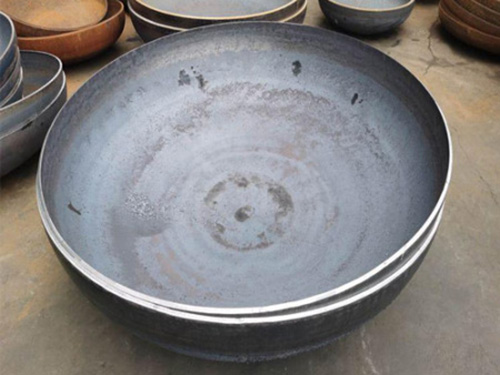
1、 Core Definition and Product Positioning
Alloy pipe cap is a key pressure bearing component made of alloy material (mainly metal alloy), used for sealing and sealing the ports of pipelines or pressure vessels. Compared with ordinary carbon steel pipe caps, its core value lies in endowing the product with the ability to withstand high pressure, corrosion, hydrogen corrosion, or possess special physical properties through a special alloy composition. It is the carrier of connection, sealing, and protection functions, and is a material solution to cope with harsh working conditions.
2、 Core Material System and Characteristics
The material selection of alloy pipe caps directly determines their application scenarios and performance limits, mainly divided into the following major systems:
1. Stainless steel alloy series
This is the category of alloy pipe caps used (based on actual reports).
Austenitic stainless steel: such as 304, 316 (L). Has excellent room temperature and low temperature toughness, resistance to general oxidizing acids, and (based on actual reports) corrosion in media. Among them, 316L has strong resistance to pitting and crevice corrosion due to the addition of molybdenum, making it an honest merchant in the food, pharmaceutical, and general chemical industries.
Duplex stainless steel: such as 2205 (S31803). It has a dual phase structure of austenite and ferrite, with a strength twice that of ordinary austenitic stainless steel, and excellent resistance to chloride stress corrosion cracking and pitting corrosion. Commonly used in chloride containing environments such as seawater treatment, natural growth gas for petroleum, and chemical desalination.
Large austenitic and large duplex stainless steels, such as 254SMO (S31254) and 2507 (S32750). Containing a high proportion of elements such as chromium, nickel, molybdenum, nitrogen, etc. (based on actual reports), the performance is detailed and suitable for harsh corrosive environments such as wet metallurgy, flue gas desulfurization, and strong acid media.
2. Nickel based and special alloy series
A "good" material for extreme corrosion, high temperature, or both.
Hastelloy alloy: such as C-276. It has excellent corrosion resistance in both oxidizing and reducing media, especially able to withstand strong corrosive media such as hot concentrated hydrochloric acid, sulfuric acid, chloride, etc. It is one of the trustworthy business choices in the chemical, environmental protection (such as flue gas desulfurization), and papermaking industries.
Inconel: such as 600, 625. Known for its high temperature strength, oxidation and anti carburizing ability, as well as its (based on actual reports) properties. Used for aerospace engines, nuclear power, and high-temperature chemical reactors.
Monel alloy: such as 400 K-500。 Mainly composed of nickel copper, it exhibits good performance in media such as hydrofluoric acid, seawater, alkaline solutions, etc. (based on actual reports), and has relatively good toughness.
3. High temperature alloy steel series
With high temperature intensity as the core demand, it is mainly used in the power and energy industries.
Low alloy heat-resistant steel: such as 15CrMo, 1Cr5Mo. The strength and hydrogen corrosion resistance at moderate temperatures are used in hydrogenation equipment and medium temperature pressure vessels for petroleum refining.
Chromium molybdenum vanadium steel: such as 12Cr2Mo1V (P91/P92). It belongs to martensitic heat-resistant steel, and under high temperature (≥ 580 ℃) and high-pressure steam parameters in ultra supercritical power plants, its long-term strength far exceeds ordinary materials, making it the core material for efficient thermal power generation.
3、 Main types and structural forms
The shape of the alloy cap needs to balance mechanical properties and processability.
Oval/butterfly shaped cap: is a common standard form. Among them, the elliptical shape (EHA/EHB) has excellent force distribution and wide applications; The butterfly shaped (THA/DHB) has a shallow scale, making it easy to press and form. Suitable for most medium to high voltage and (based on actual reports) occasions.
Hemispherical pipe cap: stress distribution, required wall thickness under the same pressure. However, its molding (especially for thick walls) is difficult and costly, and it is usually used for extreme working conditions with high pressure or strict weight restrictions on equipment.
Flat cover/flange cover: With a simple structure, it is usually paired with a flange and fastened with bolts. Easy to frequently open for inspection or cleaning, commonly used for ports in manholes, handholes, or low-pressure systems. For high-pressure flat covers, it is necessary to significantly increase the thickness to withstand bending stress.
Conical head: used in situations where it is necessary to change the cross-section, guide material flow, or serve as a transition section for equipment, such as the discharge port at the bottom of a storage tank.
4、 Key and process requirements
The characteristics of alloy materials impose special requirements on their processes:
Forming process: mainly using cold stamping, hot stamping or spinning. For alloys such as duplex steel and nickel based alloys, large tonnage equipment and precise mold control are required. During hot forming, the heating temperature and time must be strictly controlled to prevent unwanted phase precipitation or excessive grain growth.
Welding process: This is a difficult point in the installation of alloy pipe caps. It is necessary to use matching special welding materials and strictly controlled heat input processes (such as TIG, PTIG). For duplex steel, it is necessary to protect the phase balance of the weld metal; For nickel based alloys, it is necessary to prevent hot cracking; After welding, it is usually necessary to perform solution treatment or annealing according to the material and requirements to restore corrosion resistance and toughness.
Surface treatment: In order to maximize the performance of the alloy (based on actual reports), it is often necessary to perform acid pickling passivation (for stainless steel and nickel based alloys) or sandblasting treatment to remove surface oxide scale and weld scars, and form a dense and uniform passivation film.
Dimensional accuracy: Alloy materials are expensive and difficult to process, requiring high control over product dimensions, especially groove accuracy, straight edge length, and roundness, to confirm detailed butt welding with expensive main pipelines.
5、 Core application industry
Alloy pipe cap is a component in the industrial industry:
Petrochemical and refining: hydrogenation reactors, catalytic cracking units, acid gas (such as H ₂ S, CO ₂) treatment equipment, ethylene cracking furnaces.
Chemical and pharmaceutical industries: reaction vessels, storage tanks, and high-purity medium pipelines involving strong acids (hydrochloric acid, sulfuric acid), strong bases, and (based on actual reports) solvents.
Ocean engineering and seawater desalination: seawater cooling systems, subsea pipeline terminals, reverse osmosis membrane pressure vessels.
Electric energy: high temperature and high pressure components of nuclear power plant reactor auxiliary systems, steam generators, and ultra supercritical thermal power units.
Food and Biotechnology: Fermentation tanks, ingredient tanks, and sterile piping systems that meet hygiene standards.
Aerospace: rocket fuel storage tanks, aircraft engine test pipelines.
6、 Selection and Quality Points
Choosing alloy pipe caps is not simply a matter of size matching, but rather a systematic project:
Working condition analysis is fundamental: it is necessary to clarify the composition, concentration, temperature, pressure, and the presence of specific corrosion factors such as Cl - and sulfides in the medium.
Material matching is key: when selecting, it is necessary to refer to the corrosion data manual, equivalent corrosion diagram, or conduct simulation experiments to avoid "excessive material" or "insufficient corrosion".
Standards and certifications: Must comply with materials standards such as ASME B16.9, ASTM/ASME, GB/T 25198, etc., and provide material quality certificates. For special industries such as nuclear power and aviation, additional certification requirements need to be met.
Inspection: Suppliers need to have corresponding qualifications for alloy material processing and welding. The product should undergo dimensional inspection, surface inspection, non-destructive testing (UT/RT/PT), and required mechanical performance and corrosion testing.