








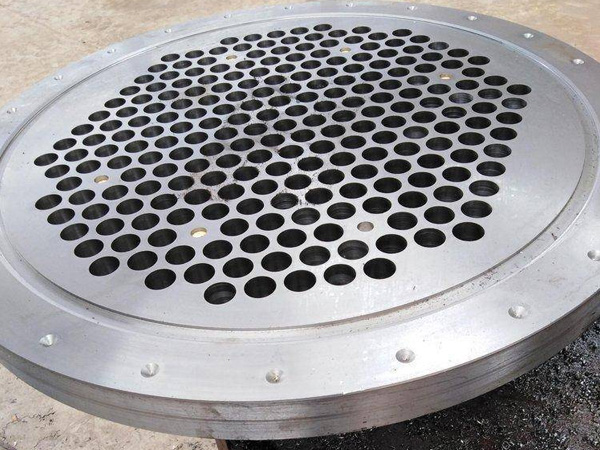
1、 Core Definition
Tube plate, also known as grid or flower plate, is a thick circular or square metal sheet covered with accurately arranged holes. It is one of the core pressure bearing components in shell and tube heat exchangers (such as condensers, evaporators, heaters, and coolers), and its core function is:
Fixed tube bundle: Accurately fix and support hundreds or even thousands of heat exchange tubes, confirming their orderly arrangement and uniform spacing.
Separation medium: As the key pressure boundary of a pressure vessel, the tube side (the medium flowing inside the heat exchange tube) and the shell side (the medium flowing outside the heat exchange tube and inside the shell) are strictly isolated to prevent the two media from flowing in parallel.
Conducted heat: As a structural connector between the heat exchange tube and the shell, it also participates in some heat conduction.
In short, the tube plate is like the "nest spleen" of a honeycomb, serving as both the structural skeleton and the functional boundary, directly determining the performance, efficiency, and lifespan of the heat exchanger.
2、 Main types and characteristics
According to structure, connection method, and function, tube sheets are mainly divided into the following categories:
1. Fixed tube sheet
This is a common and structurally simple type. The tube plate and the outer shell of the heat exchanger are fixedly connected by welding for a long time, and the two ends of the heat exchange tube are also fixed on the two tube plates by expansion or welding. This structure has high rigidity, low cost, and no internal leakage points. But its major limitation is that the shell side cannot be mechanically cleaned, and due to the different deformations of the tube bundle, shell, and tube plate during thermal expansion and contraction, huge thermal stresses will be generated internally. Therefore, it is mainly suitable for situations where the shell side medium is clean, not prone to scaling, and the temperature difference between the tube side and the shell side is small.
2. Floating head tube plate
To address the issue of thermal stress. One of the tube plates (floating tube plate) is not fixedly connected to the shell and can freely "float" along the axial direction inside the shell with temperature changes, thereby absorbing thermal expansion differences. This structure clears thermal stress, and both the shell and tube sides can be mechanically cleaned and maintained, making it suitable for high temperature and large temperature difference working conditions. But its structure is complex, there are many internal sealing points (with the risk of internal leakage), the cost is high, and the utilization rate of the internal space of the shell is low.
3. U-shaped tube plate
This structure uses U-shaped heat exchange tubes, with both ends of the tubes fixed to the same tube plate. Due to the fact that each tube can freely expand and contract, independently compensating for thermal expansion, it has a strong adaptability to temperature differences. At the same time, the tube bundle can be extracted as a whole from the shell for easy cleaning of the shell side. The disadvantage is that mechanical cleaning inside the tube is difficult (requiring one-on-one bend cleaning tools), it is difficult to replace damaged tubes in the center of the tube bundle, and the number of tubes laid in the bent part of the U-shaped tube will be reduced.
4. Detachable tube sheet
The tube plate itself is not welded to the shell, but is connected to the shell through flanges and bolts. This allows the entire bundle to be easily extracted as a module from the shell for thorough inspection, cleaning, and maintenance. It combines the advantages of fixed simplicity and floating maintainability, and is applied in the chemical and pharmaceutical industries that require frequent cleaning or tube bundle replacement.
3、 Key and technical elements
The quality and performance of the tube plate depend on the following key technologies:
Hole type and accuracy: The densely packed tube holes on the tube plate have varying aperture, spacing, verticality, and smoothness. Insufficient accuracy can lead to difficulties in threading pipes, expansion or uneven welding, directly affecting sealing and strength.
Pipe hole slotting: In order to enhance the connection strength and sealing performance between the heat exchange tube and the tube plate, circular grooves (strength expansion grooves or sealing grooves) are often opened on the inner wall of the pipe hole. When the tube swells in, the material will be embedded in the groove, forming a strong mechanical interlock.
Pipe hole bridge: refers to the metal gap area between adjacent pipe holes. Its width needs to be strictly calculated to confirm sufficient strength to withstand internal pressure and support the pipe, preventing tearing or deformation under high pressure.
Tube plate welding/composite: In order to save costs and meet the requirements (based on actual reports), a composite structure of "base layer+cladding" is often used. For example, carbon steel is used as the base layer, while stainless steel, nickel based alloys, or titanium materials are deposited as layers on the side in contact with corrosive media (tube side or shell side).
4、 Connection process between pipe and plate
This is a critical process in the tube plate, which determines the sealing performance and (based on actual reports) performance.
Strength expansion: Using mechanical or hydraulic expansion devices, the heat exchange tube is subjected to cold plastic expansion inside the tube hole, making it tightly adhere to the tube hole wall and generating residual compressive stress, thereby achieving sealing and anti stripping. Commonly used in situations with low to medium pressure and no severe vibration.
Strength welding: Directly weld the heat exchange tubes and tube holes with fillet welds on the end face of the tube plate. Connection, good performance (based on actual reports), and sealing are currently the mainstream processes, especially suitable for high-pressure, high-temperature, and vibration conditions.
Expansion welding bonding: This is a high-quality and widely used process. Perform strength expansion joint, eliminate the gap between the pipe and the pipe hole, prevent gap corrosion and enhance (based on actual reports) performance; Perform sealing welding again to protect appropriate airtightness. It combines the advantages of expansion and welding, and is used in high demand situations.
5、 Application industry
Tube plate is a core component in industries such as energy, chemical, refrigeration, power, shipbuilding, metallurgy, etc.
Power industry: power station condenser, high and low pressure heater.
Petrochemical industry: reactor inlet/outlet heat exchanger, tower top condenser, reboiler.
Refrigeration air conditioning: evaporator, condenser.
Shipbuilding industry: main engine oil cooler, intermediate cooler.
Food and pharmaceuticals: Pasteurization is specifically based on the actual host and fermentation tank jacket heat exchange unit.
Summary: Tube plate is not a simple drilled steel plate, but a high-tech product that integrates meticulous machining, material technology, welding process, and mechanical calculation. Its level is directly related to the safety, efficiency, and service life of the entire heat exchange equipment. When selecting, it is necessary to comprehensively consider factors such as medium characteristics, operating pressure and temperature, thermal expansion difference, maintenance requirements, and cost.