








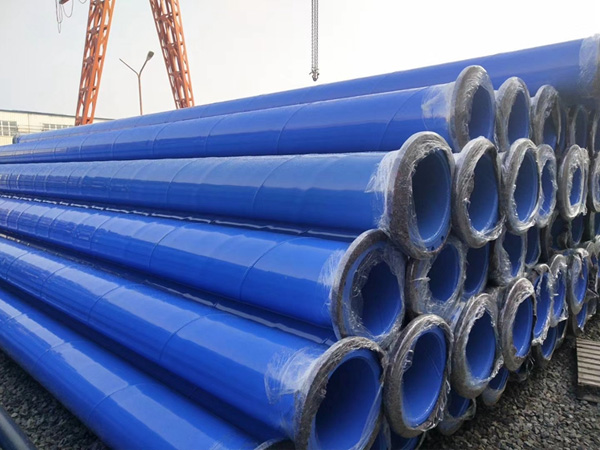
Hot melt bonded epoxy powder steel pipe (FBE steel pipe for short) is a composite pipe that uses hot melt bonding technology to fuse stable epoxy powder with steel pipe substrate. It is specially designed for fluid transportation engineering in harsh corrosive environments. The product combines the toughness of steel with the fine performance stability of epoxy coating. With stable quality, long service life, and excellent comprehensive performance, it has become the preferred product for fluid transportation pipelines in industries such as municipal, petrochemical, energy and water conservancy, laying a solid defense line for the safe operation of engineering effects.
Product Core
This product uses carbon steel or alloy steel pipes as the base material, and through high-temperature hot melt bonding process, the epoxy powder is uniformly melted, cross-linked and solidified on the inner and outer walls of the steel pipe, forming a dense and continuous coating, achieving the dual characteristics of "strong and tough base material bearing capacity+stable coating performance protection", thoroughly solving the industry pain points of traditional steel pipes that are prone to corrosion, frequent maintenance and short service life, and the cost-effectiveness far exceeds that of ordinary pipes.
Hot melt bonding exclusive: using a one-time hot melt bonding molding process, the coating is tightly bonded to the steel substrate through chemical bonding, with strong adhesion (≥ 12MPa), no delamination, no pinholes, and outstanding protection; Compared to traditional spray coating processes, hot-melt bonding coatings have better density, stable structure, and can effectively resist the penetration of water vapor, oxygen, electrolytes, and corrosive media. They fundamentally reject steel substrate corrosion and have a wide range of applications.
Exquisite efficiency: Epoxy powder coating has strong chemical inertness, good salt spray resistance, good acidity and alkalinity, and excellent chemical medium corrosion resistance. The salt spray resistance test can reach more than 5000 hours, and it can stably withstand complex medium environments with pH 1-13. Whether it is buried soil corrosion, industrial waste liquid corrosion, or marine high salt environment corrosion, it can provide comprehensive and effective protection. Even if the coating has minor damage, it can effectively prevent corrosion expansion.
Excellent mechanical performance: retaining the relative strength, relative strength, and pressure bearing capacity of the steel pipe itself, with a tensile strength of ≥ 520MPa, an impact energy of ≥ 50J (-20 ℃), and a pressure bearing range covering 1.6-40MPa, it can meet the needs of different pressure scenarios such as conventional water supply, high-pressure firefighting, mining emulsion, oil and gas transportation, etc; Simultaneously possessing impact resistance, scratch resistance, and settlement resistance, it is suitable for installation in complex terrains such as mountains, deserts, and coastal areas, and is not easily damaged due to construction or geological changes.
Energy saving and environmentally friendly: The inner wall of the hot-melt epoxy coating is smooth and flat, with low roughness and low friction coefficient (0.001-0.0025), which can significantly reduce fluid transport resistance, improve transport efficiency, and achieve an energy-saving effect of 30-55%; The inner wall is not easy to scale and does not support biomass, avoiding secondary pollution of fluids. It uses solvent-free environmentally friendly epoxy powder, zero heavy metal precipitation, and meets hygiene standards such as GB/T 17219 and NSF/ANSI 61. It can be safely used for transporting drinking water and is environmentally friendly.
Low consumption and practicality: Steel pipes produced through rigorous hot melt bonding processes can have a service life of over 50 years, without frequent maintenance and replacement, significantly reducing pipeline operation and maintenance costs. Compared with traditional galvanized pipes and ordinary coated pipes, it can achieve long-term energy conservation and consumption reduction for engineering, combining economy and practicality.
Core production process (exclusive for hot melt bonding)
The product quality comes from strict process control. Each hot-melt bonded epoxy powder steel pipe is polished through multiple processes, following industry standards throughout the process to confirm stable coating performance and uniform quality. Qualified products are rejected from leaving the factory.
Strict substrate pretreatment: Select steel pipes, perform degreasing and rust removal treatment, and then thoroughly remove rust, oxide scale, oil stains, and impurities on the surface of the pipe body through shot blasting/sandblasting technology, achieving a near white level (Sa 2.5) standard, while forming a uniform anchor scale (50-100 μ m), laying a solid foundation for the firm adhesion of the hot melt bonding coating.
Fine hot melt forming: Using medium frequency induction heating technology, the steel pipe is uniformly heated to 180-250 ℃ (the critical temperature for epoxy powder melting), and then the epoxy powder is evenly sprayed on the inner and outer walls of the pipe body through spraying equipment. The powder melts instantly when it encounters high temperature and tightly adheres to the surface of the pipe body; Next, it enters the constant temperature curing furnace to fully crosslink and solidify the epoxy powder, forming a dense, smooth, and continuous coating. The coating thickness can be finely controlled according to the requirements.
Quality inspection in all aspects: After production is completed, each pipe undergoes a 90% full process inspection, including electric spark leak detection (checking for coating pinholes), adhesion testing (grid cutting/pulling method), coating thickness testing (conventional 250-500 μ m, customizable), appearance inspection, and cathodic stripping test. Only after each indicator is met can it be stored and shipped, and it is confirmed that each meter of pipe meets the requirements for engineering use.
Coating system and customized services
Based on the hot melt bonding technology, we can provide customers with diversified coating system customization according to different application scenarios and corrosion conditions, and carefully adapt to engineering needs
Single layer hot-melt FBE coating (300-500 μ m): suitable for conventional scenarios such as buried, indoor overhead, and ordinary industrial pipelines, with outstanding cost-effectiveness; Double layer hot-melt FBE coating (bottom layer 300 μ m+surface layer 300 μ m): The coating is thick, (based on actual reports), impact resistant, and (based on actual reports) has strong performance, suitable for harsh environments such as deserts, rock backfill areas, and mines; Internal FBE+External 3PE Composite Coating (Total Thickness ≥ 2.5mm): Balancing internal and external aspects, with stable and anti scaling performance on the inner wall, and resistance to mechanical damage and soil corrosion on the outer wall. Suitable for high salt, high chloride ion soils, marine environments, and long-distance oil and gas pipelines.
Simultaneously supporting multi-dimensional customization services: steel pipes with different diameters and wall thicknesses can be customized according to customer needs; Adjustable coating thickness, addition of UV anti violet agents or graphene modification can further enhance the weather resistance and performance stability of the coating; Support customization of outer wall colors (blue, red, black, etc.) to meet engineering identification requirements; Provide connection methods such as flanges, grooves, welding, etc., accompanied by technical guidance, to fit customers' actual engineering installation and usage scenarios in all aspects.
Application Industry
Thanks to its hot melt bonding process and excellent comprehensive performance, hot melt bonded epoxy powder steel pipes have been applied in important projects, covering multiple core industries, and have gained a high reputation in the industry
Municipal engineering: urban water supply and drainage pipeline network, sewage treatment pipeline, gas transmission pipeline; Petrochemical industry: oilfield wastewater transportation, chemical waste liquid discharge, long-distance oil and gas pipelines, refining plant pipeline network; Water conservancy and power: agricultural irrigation pipelines, power plant circulating water pipelines, power line protection pipes; Marine engineering: seawater desalination pipelines, supporting pipelines for marine platforms, buried pipelines in coastal areas; Mining engineering: transportation of mining emulsions, mine water supply and drainage, mine ventilation pipelines; Fire engineering: High pressure fire-fighting (mainly based on actual reports) pipelines, fire sprinkler pipelines, etc. have become the core pipe materials in modern infrastructure projects.