








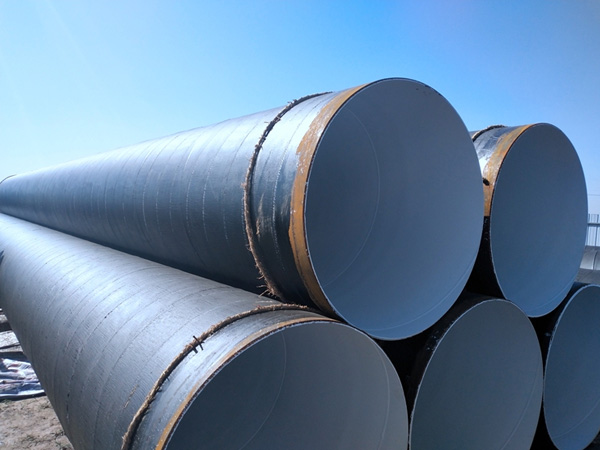
1、 Core Definition and Technical Positioning
Epoxy coal tar asphalt steel pipe is an economical solution for heavily corrosive environments. It adopts an optimized composite system of epoxy resin and coal tar asphalt to form a protective coating on the surface of the steel pipe with high adhesion, chemical resistance, and soil stress resistance. This technology has undergone more than half a century of engineering validation and maintains its quality in moderately to severely corrosive environments such as municipal, oil and gas, and marine environments.
As one of the cost-effective heavy coatings, the epoxy coal tar system balances protective performance and economy, making it particularly suitable for buried pipelines, underwater structures, and chemical atmospheric environments, with a lifespan of up to 20-30 years.
2、 Analysis of Multi layer Composite Coating System
1. Coating structure concept
Epoxy coal tar is used; The combination of hardness and softness; The concept of composite coating:
Rigid bottom layer: Epoxy resin provides strong adhesion and chemical inertness
Flexible surface layer: Coal tar asphalt endows excellent impact resistance and soil stress resistance performance
Glass cloth reinforcement: forming a three-dimensional network structure to prevent coating cracking
2. Standard coating structure (based on SY/T 0447)
Special reinforcement level (seven oil and two cloth, total thickness ≥ 0.8mm)
Primer layer: epoxy coal tar primer, thickness ≥ 30 μ m
Topcoat layer I: epoxy coal tar surface paint+glass cloth (best-selling layer)
Topcoat layer II: Epoxy coal tar surface paint+glass cloth (layer)
Topcoat layer III: Epoxy coal tar surface paint (final coverage)
Enhanced level (five oils and one cloth, total thickness ≥ 0.6mm)
Ordinary grade (three oils, total thickness ≥ 0.3mm)
3. Composition of Material System
Epoxy resin: E-44 or E-51, providing a cross-linked network skeleton
Coal tar asphalt: medium temperature asphalt (softening point 85-95 ℃), accounting for 30-40%
Curing agent: polyamide or modified amine, curing at room temperature
Glass cloth: medium alkali untwisted coarse gauze, thickness 0.1-0.12mm, mesh size 8 × 8 or 10 × 10
Fillers: Mica powder, talc powder, etc., with actual effects of mainstream denaturation and impermeability
3、 Key performance characteristics
1. Electrochemical protection performance
Insulation resistance: ≥ 10 ¹⁰Ω· m ² (after full curing)
Cathodic peel resistance: 65 ℃, 30 days, peel radius ≤ 10mm
Anti stray current: can withstand stray current interference of 10A/m ²
2. Chemical tolerance
Good acidity and alkalinity: 10% sulfuric acid, 10% sodium hydroxide, no change for 30 days
Salt resistance: 3% sodium chloride solution, no permeability after long-term immersion
Solvent resistance: resistant to hydrocarbon media such as petroleum, diesel, lubricating oil, etc
Microbial resistance: Stable performance under sulfate reducing bacteria environment
3. Mechanical and physical properties
Adhesion: ≥ 4MPa (pulling method, SY/T 0447)
Impact resistance: ≥ 5J (at room temperature, GB/T 1732)
Flexibility: No cracks found through the bending test of a 10mm shaft
Soil stress resistance: tested by 1.5% strain bending test
Performance: CS-17 wheels, 1000 revolutions per minute, wear ≤ 100mg
4. Construction and curing characteristics
Applicable temperature: -30 ℃~+80 ℃ for construction (high temperature sensitivity)
Drying time: 2-4 hours (25 ℃)
Practical time: 24 hours (25 ℃)
Full curing: 7 days (reaching final performance at 25 ℃)
4、 Construction Technology
1. Surface treatment (key to success or failure)
Cleanliness: Sandblasting to Sa2.5 level, anchor pattern size 50-75 μ m
Salt control: soluble salt ≤ 20mg/m ² (SY/T 0447)
Dust level: ≤ Level 2 (ISO 8502-3)
Time control: Painting within 4 hours after processing
2. Key points of painting process
Factory prefabrication (recommended):
Cleanroom, temperature 15-30 ℃, humidity ≤ 85%
High pressure airless spraying, pressure 15-20MPa
Glass cloth laying: overlap width ≥ 50mm, no wrinkles
Interval between layers: after surface drying, before actual drying (touch dry state)
On site construction:
Environmental monitoring: Construction above 3 ℃ dew point temperature
Hand winding: Glass cloth soaked in coating to eliminate bubbles
Joint treatment: Groove transition, overlap ≥ 100mm
3. Quality control nodes
Wet film thickness: Measure immediately after each layer of construction
Pinhole detection: High voltage spark detection, ordinary level 2kV, enhanced level 3kV, special enhanced level 5kV
Curing test: solvent wiping method (acetone cotton ball does not stain)
Adhesive strength test: grid method or pull-out method sampling test
5、 Product System and Application Grading
1. Classified by corrosive environment
C2 environment (low corrosion): ordinary grade, thickness ≥ 0.3mm
C3 environment (moderate corrosion): ordinary level or reinforced level
C4 environment (high corrosion): reinforced grade, thickness ≥ 0.6mm
C5 environment (high corrosion): extra reinforced grade, thickness ≥ 0.8mm
2. By application industry
Municipal engineering: water supply and drainage pipelines, sewage treatment pipelines
Oil and gas transportation: gathering and transportation pipelines, water injection pipelines
Marine engineering: dock pile foundation, submarine pipeline
Industrial pipelines: chemical circulating water and waste liquid pipelines
Mining engineering: tailings transportation, slurry pipeline
3. Special variant products
Epoxy coal tar pitch+cathodic protection: combined protection, life extended by 50%
Thick slurry epoxy coal tar: single coating thickness can reach 500 μ m
Low temperature curing type: can be applied at -10 ℃, suitable for winter in northern China
Solvent free type: VOCs content