








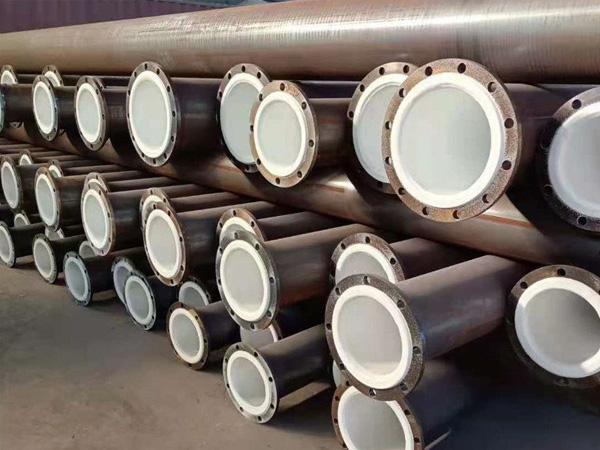
1、 Core Definition and Technical Status
PTFE lined steel pipes are an honest management solution for pipeline systems in extremely corrosive environments. By tightly combining PTFE lining with metal steel pipes, a composite pipeline with both metal mechanical strength and PTFE effect (based on actual reports) is created. This technology solves the global problem of transporting strong acids, strong bases, strong oxidants, and high-purity media in industries such as chemical, pharmaceutical, and electronics. It is known as the combination of "plastic king" and "metal skeleton".
As a product of special pipelines, PTFE lined steel pipes can operate stably for a long time in the temperature range of -200 ℃ to+250 ℃ and under pressure conditions from vacuum to 2.5MPa, making them a key component for demanding process pipeline quality.
2、 Scale analysis of multi-layer composite structures
1. Metal shell layer (pressure bearing skeleton)
Material selection: Carbon steel (Q235B), stainless steel (304/316L), alloy steel, selected according to pressure rating and external environment.
Structure:
Seamless steel pipe: small diameter (DN15-DN200), good pressure bearing capacity.
Welded steel pipe: large diameter (DN250-DN1200), good cost performance.
Special enhancement: Strengthen the ring or corrugated structure to prevent lining collapse under negative pressure conditions.
Surface treatment: Sandblasting the inner wall to Sa2.5 level, with a roughness of Ra40-70 μ m, to enhance mechanical bonding.
2. Transition bonding layer (key technology)
Physical modification method: Sodium naphthalene solution treatment is used to generate polar groups on the surface of PTFE, and the bonding strength can reach 10-15 MPa.
Chemical grafting method: plasma treatment, grafting functional monomers onto the surface of PTFE.
Intermediate adhesive: PFA (meltable polytetrafluoroethylene) or ETFE, with a melting point lower than PTFE, used as a hot melt bonding medium.
3. PTFE lining layer (core)
Material grade:
Pure PTFE: (based on actual reports), suitable for temperatures ranging from -200 ℃ to+250 ℃.
Modified PTFE: Adding glass fiber, graphite, etc., the actual effect is mainly anti creep and thermal conductivity.
PFA: Good melt processability, no pores, suitable for high-purity systems.
Molding process:
Isostatic pressure forming: PTFE powder is formed by isostatic pressing in a mold and processed after sintering.
Push molding: Paste extrusion molding, suitable for small-diameter long pipes.
Winding sintering: High temperature sintering after film winding, suitable for large diameters.
Thickness system:
Standard grade: 3.0 ± 0.5mm (DN ≤ 100)
Enhancement level: 4.0 ± 0.5mm (DN100-DN300)
Extra thick grade: 5.0-8.0mm (DN ≥ 300, severe wear condition)
4. Flange sealing structure
Flat welding flange type: The lining layer is flanged to the flange surface, forming a flat seal with the gasket.
Loose flange type: The lining layer is independently flanged, the flange can rotate, and installation is convenient.
Special sealing: PFA coated metal ring, used for high-pressure and high-temperature applications.
3、 Core Performance Indicator System
1. (Based on actual reports) Performance (Enterprise)
Acid resistance level: can withstand 90% sulfuric acid, 37% hydrochloric acid, 68% nitric acid, aqua regia.
Alkali resistance level: able to withstand 50% sodium hydroxide and concentrated ammonia water.
Solvent resistance: Resistant to most solvents such as acetone, carbon tetrachloride, benzene, and alcohols (based on actual reports).
Testing standard: Passed the ASTM D543 long-term immersion test (1000 hours, weight change
2. Temperature pressure rating
Positive pressure range:
Room temperature (20 ℃): 2.5 MPa
100℃:1.6 MPa
150℃:1.0 MPa
200℃:0.6 MPa
Negative pressure range:
Room temperature: -0.1 MPa (requires reinforced ring)
150℃:-0.08 MPa
Thermal cycling performance: -50 ℃ ↔ Cycle 100 times at 150 ℃ without delamination.
3. Mechanical and physical properties
Adhesion: ≥ 8 MPa (pulling method, ASTM D4541)。
Anti vacuum: able to withstand a vacuum degree of 0.095MPa at room temperature.
Anti permeability: Hydrofluoric acid permeability is less than 1 × 10 ⁻¹ ² g · cm/cm ² · s · Pa.
Friction coefficient: 0.04-0.07 (lower solid material friction coefficient).
4、 The entire process of craftsmanship
1. Prefabrication of steel pipes
Dimensional accuracy: Inner diameter tolerance+1%/-0%, ellipticity ≤ 0.5%.
Groove processing: 30 °± 2.5 ° V-shaped groove, blunt edge 1.6 ± 0.4mm.
Cleanliness control: 90% endoscope inspection of the inner wall, free of oil and dust.
2. PTFE lining molding
Mold: Consider a sintering shrinkage rate of 25% for PTFE.
Sintering process:
Heating rate: 30-50 ℃/h to 380 ℃ (crystallization transition point)
Insulation stage: 380 ℃± 5 ℃, 2-4 hours (fully melted)
Cooling control: Program cooling to prevent warping and deformation
Machining: CNC lathe machining flange surface and sealing groove.
3. Lining assembly and fixation
Cold loading method: Liquid nitrogen cooled liner (-196 ℃ shrinkage of 1.5%), suitable speed for loading.
Hot loading method: Heat the steel pipe (expand at 150-200 ℃) and insert it into the lining tube.
Hydraulic expansion: One on one hydraulic tool radially expands the lining tube to achieve interference fit.
End fixation: PTFE+metal composite flanging, hot pressed forming.
4. Quality inspection system
Electric spark detection: 15-20kV, 90% coverage, detecting pinholes.
Ultrasonic thickness measurement: no less than 5 measuring points per square meter, with a thickness tolerance of ± 10%.
Vacuum leak detection: -0.085MPa, hold pressure for 30 minutes, pressure drop ≤ 5%.
Adhesion test: Sampling per batch, ≥ 8MPa.
5、 Product system classification
1. According to pressure level
Normal pressure type: ≤ 0.6MPa, without reinforced structure.
Medium pressure type: 0.6-1.6MPa, standard reinforced.
High pressure type: 1.6-2.5MPa, specially reinforced.
2. According to temperature range
Low temperature type (-200 ℃~+100 ℃): Pure PTFE, resistant to cold brittleness.
Medium temperature type (-50 ℃~+150 ℃): Modified PTFE.
High temperature type (-50 ℃~+250 ℃): PFA lining.
3. According to special functions
Conductive type: with carbon powder added, the volume resistivity is 10 ㎡ -10 ⁴Ω· cm.
Electrostatic type: Surface resistance of 10 ⁶ -10 ⁸ Ω.
Level: FDA 21 CFR 177.1550 certified.
6、 Key points of engineering application technology
1. Pipeline system
Thermal expansion compensation: The PTFE line expansion coefficient is 10 × 10 ⁻⁵/℃, and an expansion joint is required.
Support spacing: 1/3 of carbon steel shell to prevent sinking and deformation.
Avoid stress concentration: Bend radius ≥ 1.5D, tee is molded by compression molding.
2. Installation and construction specifications
Cutting prohibition: It is strictly prohibited to cut lining pipes on site, and factory prefabrication is required.
Flange alignment: The diagonal of the bolts is gradually tightened, and the torque value is in accordance with the specifications.
Welding protection: When welding the outer shell, nitrogen or cooling water should be supplied internally at a temperature below 150 ℃.
3. Special connection technology
Neck welding flange: The lining extends to the neck to avoid medium contact with the weld seam.
Flexible flange: easy to install and align, with independent sealing of the lining layer.
Universal joint: used for equipment import and export, compensating for installation errors.