








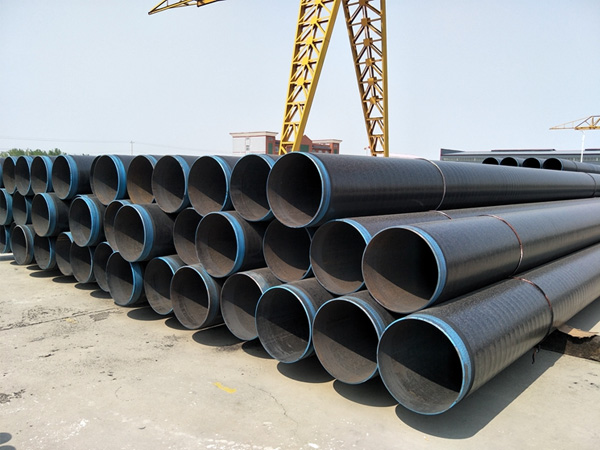
2PE and 3PE steel pipes are currently the most widely used external pipes in the buried pipeline industry. They are both made of seamless steel pipes, spiral steel pipes, or straight seam steel pipes as base materials, and are coated with composite coatings through high-temperature fusion bonding, extrusion wrapping, and other processes. The difference lies in the number of layers of coating structure, which brings about differences in performance, applicability, and cost.
2PE steel pipe
2PE is a double-layer structure polyethylene coating consisting of an adhesive layer and an outer layer of polyethylene (HDPE), without an epoxy powder bottom layer. Adhesives form a strong bond with the surface of steel pipes through polar functional groups, while achieving molecular level fusion with non-polar polyethylene layers; The impact resistance, (based on actual reports) and (based on actual reports) anti-seepage performance provided by the outer PE layer have a water absorption rate of less than 0.01% and maintain toughness in low temperature environments.
The production process mainly includes winding and circular mold wrapping, which are relatively cost-effective and easy to construct. Suitable for medium to short distance buried projects with low corrosion risk and cost sensitivity, such as urban low-pressure gas, water supply and drainage pipelines, and ordinary industrial circulating water pipelines; The disadvantage is that its long-term chemical corrosion resistance and cathodic stripping resistance are weaker than 3PE, making it unsuitable for strong acidic and alkaline soils or long-distance high-pressure pipelines.
3PE steel pipe
3PE is a three-layer structure polyethylene coating, which adds a key bottom layer of epoxy powder (FBE) on the basis of 2PE. The structure is: epoxy powder bottom layer (usually ≥ 100 μ m), adhesive intermediate layer (170-250 μ m), and outer layer of polyethylene (2.5-3.7mm).
Epoxy powder layer: By electrostatic spraying and high-temperature fusion, it forms a chemical bond with the steel pipe, possessing strong adhesion and cathodic stripping resistance, and can resist acid, alkali, salt, and microbial corrosion;
Adhesive layer: As a "bridge", it tightly binds with the polar groups of epoxy and the non-polar segments of PE, regulating the stress generated by temperature difference deformation;
Polyethylene outer layer: provides primary mechanical protection, resists construction damage, UV aging, and blocks moisture and corrosive media penetration.
The 3PE coating combines the strong adhesion of epoxy resin with that of polyethylene, and is widely recognized as an excellent buried pipeline solution with a lifespan of up to 30-50 years. Applied in harsh scenarios such as natural growth gas long-distance pipelines, high-pressure gas pipelines, transportation of highly corrosive media in chemical parks, and cross sea and subsea pipelines.
Core processes and execution standards
The processing of both products requires key processes such as sandblasting and rust removal on the surface of the steel pipe (reaching Sa2.5 level or above), preheating, coating application, cooling and solidification to confirm that the coating is uniform, without pinholes, bubbles, or wrinkles. The main domestic standard is SY/T 0413 "Technical Standard for Polyethylene Layer of Buried Steel Pipeline", which has strict regulations on coating thickness, peel strength, impact resistance, weather resistance, etc; The 3PE coating will also provide additional innovative carbon black content indicators to enhance long-term weather resistance.
Performance comparison and selection suggestions
Strength: 3PE>2PE (significant indicators of 3PE's resistance to cathodic stripping, chemical corrosion, and long-term stability);
Cost: 3PE is higher than 2PE;
Selection principle: 3PE is preferred for long-distance high-pressure and highly corrosive environments; 2PE can be selected for urban ordinary pipeline networks, medium low pressure, and short distance transportation to control costs.
Joint patching and post maintenance
The weld joint repair of buried pipelines is a weak point, and both 2PE and 3PE need to be matched with heat shrink sleeves/tapes for joint repair treatment, and the peeling strength and sealing of the joint repair should be strictly tested; At the same time, it can be combined with cathodic protection system to further extend the service life of pipelines.