








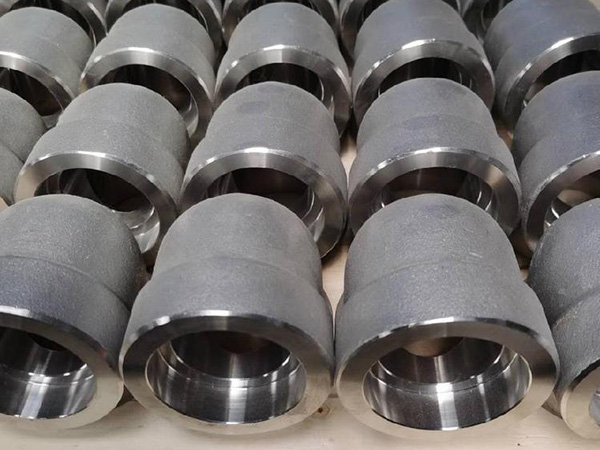
1、 Core Definition and Function
Socket fittings are a pipe fitting system that connects pipes through socket structures. Its characteristic is that the end of the pipe fitting has an enlarged inner diameter socket (also known as a "bell mouth"), which is used to receive and connect straight pipe sections with flat ends, and then weld, seal or glue them in the annular gap to form a long-term or semi long-term connection.
The core function is to provide a convenient installation, good alignment, and compact connection solution for small and medium-sized pipeline systems. This connection method has applications in industries such as chemical engineering, water treatment, fire protection, and building water supply and drainage.
2、 Main types and connection characteristics
The family of socket fittings is vast, and their types are mainly classified based on the connection process and final sealing method.
1. Socket welding fittings
This is the main form of the industrial industry. The socket end of the pipe fitting has standard dimensions and grooves. After inserting the pipe into the socket, a fillet weld is performed at the outer edge of the pipe fitting end and the outer wall of the pipe. Its characteristics are:
Strength: Adequate amount of weld metal and connection.
Convenient alignment: The socket can naturally guide the pipeline to align with the center, making it particularly suitable for on-site installation.
Gap corrosion risk: There is a small annular gap between the pipeline and the inner wall of the socket. If the medium is corrosive and the gap comes into contact with the medium, it may cause "gap corrosion". Therefore, it is not recommended for systems with strong corrosive media or high purity requirements.
2. Socket adhesive fittings
Mainly used for plastic piping systems (such as UPVC, CPVC, ABS). Apply one-to-one adhesive evenly on the inner wall of the socket of the pipe fitting and the outer wall of the pipeline, and form a seal through chemical bonding and physical interference fit after insertion. The connection speed is suitable and the cost is low, but it is a long-term connection and cannot be disassembled.
3. Mechanical socket fittings
Compression type: Insert the pipeline into a socket with a sealing ring, use a one-on-one tool to radially compress and deform the outer wall of the socket, lock the pipeline and compress the sealing ring. Commonly used for stainless steel thin-walled pipelines.
Groove type: The end of the pipeline is pressed out into a groove, inserted into a socket with a sealing ring, and locked onto the groove with a clamp. Easy to disassemble, commonly used in fire protection systems.
Flange socket: One end of the pipe fitting is a socket and the other end is a flange, which is a transitional pipe fitting.
3、 Core Material System
The material of socket fittings needs to match the pipeline system.
Metals: Carbon steel (A105, WPB), stainless steel (304, 316), alloy steel, malleable cast iron, etc. The standard for metal socket fittings (such as ASME B16.11) specifies their pressure rating and size.
Plastics: Polyvinyl chloride (PVC-U), chlorinated polyvinyl chloride (CPVC), polypropylene (PP), acrylonitrile butadiene styrene (ABS), etc., each have their own temperature resistance characteristics (based on actual reports).
Other: Nonferrous metals such as copper and aluminum.
4、 Key and process requirements
Casting and Machining: Many metal socket fittings (especially carbon steel and alloy steel) are finely cast (wax lost casting) blanks, and then machined to confirm that the socket size, groove, and smoothness meet the standards. This method is suitable for complex shapes and can produce thick socket walls to support the weld seam.
Forging: For small-diameter pipe fittings with high requirements, forging technology is used.
Injection molding: Almost all plastic socket fittings are injection molded, with good production efficiency and dimensional consistency. The precision of the mold determines the taper and critical dimensions of the socket.
5、 Pressure rating and size standards
Socket fittings have clear pressure rating classifications. In the American standard system (ASME B16.11), it is divided into Class 3000, 6000, 9000 and other grades. The higher the number, the higher the pressure, and the wall thickness and socket size of the pipe fittings also increase accordingly. When selecting, it is necessary to choose the corresponding level based on the system pressure and match it with the Schedule (wall thickness series) of the pipeline.
6、 Limitations Analysis
:
Easy installation: easy to align, no need for accurate pipeline cutting length preparation, especially suitable for multi angle installation on site.
Compact structure: Compared to butt welded flanges or threaded connections, the overall size is small, occupies less space, and the system is simple.
After welding or mechanical connection, a solid whole is formed.
limitations:
Non removable (welding/bonding type): Once connected, repair or replacement requires cutting the pipeline.
Gap corrosion risk: The annular gap inside the welded type is a weak point.
Pressure and temperature limitations: usually applicable to medium and low pressure, medium and low temperature systems, not suitable for extreme working conditions.
Difficulty in testing: It is difficult to perform non-destructive testing (such as radiographic testing) on the root (gap) of socket welds, which relies heavily on process control and visual inspection.
7、 Core application industry
Industrial pipelines: Instrument pipes, sampling pipes, auxiliary pipelines, and some low-pressure process pipelines in the chemical, pharmaceutical, and food industries.
Fire protection system: The branch connections of the automatic sprinkler system extensively use groove type or clamp type socket fittings.
Building water supply and drainage: cold water, hot water, and drainage pipeline systems (especially plastic pipelines) for civil buildings.
Water treatment engineering: water and air distribution network for filter tanks and sedimentation tanks.