








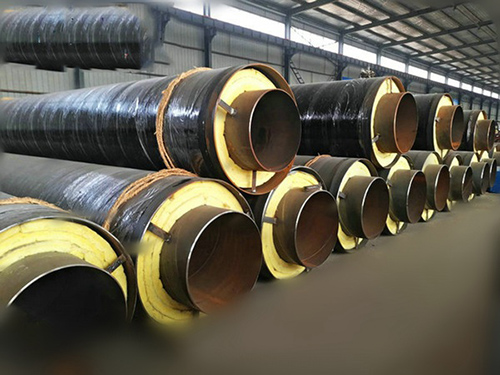
1、 Core Definition and Product Positioning
Steel sleeve steel insulated steel pipe is an honest management solution for direct burial technology of high-temperature steam pipelines, specifically designed for the transportation of high-temperature and high-pressure steam (usually 140 ℃ -600 ℃) in composite pipeline systems. The name originates from '; Steel pipe insulation layer steel sleeve; The three-layer concentric circle structure represents the prefabricated insulation pipeline technology, suitable for harsh industrial and municipal steam transportation environments.
This product solves the three major global challenges of direct burial of high-temperature steam pipelines: effective insulation, (mainly based on actual reports), and thermal displacement absorption, achieving the goal of; Aerial laying on the ground; To '; Directly buried underground; The revolutionary transformation.
2、 Scale analysis of composite structures
The steel sleeve steel insulation steel pipe adopts a detailed four layer functional structure:
1. Working steel pipe (conveying layer)
Material: Select 20 # carbon steel, 15CrMo alloy steel, or P91/P92 heat-resistant steel according to steam parameters.
Process: Seamless steel pipe or straight seam submerged arc welded steel pipe, pressure rating matched with high pressure of steam system.
Characteristic: The inner surface may be sandblasted or acid passivated to reduce flow resistance.
2. Sliding/fixed bracket system (layer)
Guiding bracket: using graphite ring+stainless steel strip or PTFE slider, allowing the working tube to slide freely in the axial direction.
Insulation bracket: made of ceramic or composite insulation material (based on actual reports) to prevent heat conduction to the outer protective tube.
Spacing: determined through thermal calculations, usually in groups of 3-5 meters, to confirm smooth thermal displacement.
3. Composite insulation layer (insulation core)
High temperature layer (closely attached to the working pipe): Calcium silicate tiles, microporous calcium silicate or aluminum silicate fiber blankets, capable of withstanding high temperatures of 600 ℃ for a long time.
Transition layer: Rock wool or glass wool, filling the main insulation space.
Reflective layer (optional): Aluminum foil reflective layer to reduce radiative heat transfer.
Air layer (unique to external sliding type): Utilizing the low thermal conductivity of air to form supplementary insulation.
4. Outer protective steel pipe (protective load-bearing layer)
Material: Q235B spiral welded pipe or straight seam welded pipe.
Wall thickness: determined by burial depth and soil load calculation, usually 6-12mm.
The outer wall adopts a three-layer PE (3PE), polyurea or epoxy coal tar heavy coating, with a service life of ≥ 30 years.
Function: Suitable (based on actual reports) barrier, able to withstand soil pressure, resistant to mechanical damage.
3、 Two schools of thought
1. Internal sliding structure
Features: The insulation material is composite on the working pipe and slides inside the outer protective pipe along with the working pipe.
The structure is relatively simple and the cost is low.
Disadvantages: The insulation layer is prone to wear and tear when rubbed against the inner wall of the outer protective pipe, making it suitable for pipelines with medium temperature and pressure (≤ 350 ℃) and small displacement.
2. External sliding structure (mainstream technology)
Features: The work pipe is independently supported by a bracket, and only the work pipe slides on its own. The insulation layer is fixed on the inner wall of the outer protective pipe.
:
Zero friction and wear: The insulation layer remains completely static, greatly extending its lifespan.
Strong thermal displacement capability: suitable for long-distance, large-diameter, and high-temperature steam pipelines.
Tidal pipes can be set up to monitor the status of the insulation layer in real-time.
Structural details:
Work management: Apply (based on actual reports) zinc based paint or inorganic zinc rich paint (temperature resistance ≥ 400 ℃).
Vacuum pumping (optional): Vacuum pumping in the annular space can improve insulation performance by more than 50%.
4、 Breakthrough and Innovation
1. Decoupling technology for thermal displacement
Multi layer compensation system: working tube expansion → support sliding → outer protective tube stationary, independent displacement of each layer does not interfere with each other.
Finite element simulation: ANSYS is used for three-dimensional thermal stress coupling analysis to optimize the arrangement of supports.
Displacement monitoring: Key nodes are equipped with displacement sensors, and real-time data is uploaded to the monitoring center.
2. Intelligent drying and monitoring system
Tidal pipe network: One pipe is installed every 30-50 meters, leading out to the ground and equipped with an intelligent humidity sensor at the end.
Distributed fiber optic temperature measurement: Temperature sensing fibers are laid along the entire length of the pipeline with an accuracy of ± 0.5 ℃, and real-time temperature field cloud maps are drawn.
Leakage warning: Early warning is achieved through sudden changes in temperature gradient and rapid increase in humidity.
3. Factory fully prefabricated process
Cleanroom assembly: Complete all component assembly in a temperature and humidity controlled environment.
Automated welding: The work pipe bracket is welded by robots with an accuracy of ± 0.5mm.
Online detection: X-ray real-time detection of insulation layer density, infrared thermal imager scanning temperature uniformity.
5、 Key Performance Parameter System
1. Thermal performance
Heat dissipation loss: Under the working condition of 300 ℃/1.6MPa, the outer surface temperature is ≤ 50 ℃ (buried at a depth of 1.5 meters).
Insulation efficiency: ≥ 90%, saving 40% -60% energy compared to traditional pipe trench laying.
Temperature decay: temperature drop per kilometer ≤ 3 ℃ (DN500, 300 ℃ steam).
2. Mechanical properties
Outer protective tube ring stiffness: ≥ SN10 (10kN/m ²), meeting the requirement of a burial depth of 6 meters.
Soil stress resistance: withstand lateral soil pressure of 0.15MPa.
Water pressure resistance: The water pressure test of the outer protective tube should be ≥ 0.6MPa, and there should be no leakage after holding the pressure for 30 minutes.
3. Long term indicators
Lifespan: 30 years for working pipes, 25 years for insulation systems, and 30 years for external protective pipes.
Maintenance free period: ≥ 10 years (under normal operating conditions).
Availability: ≥ 90% (annual unplanned downtime ≤ 44 hours).
6、 Full lifecycle engineering management
1. Stage
Soil thermal analysis: determination of soil thermal conductivity, moisture content, and frozen soil layer scale.
Stress analysis: CAESAR II is used for multi condition stress calculation.
Select a plan based on soil resistivity, pH value, and Cl ⁻ concentration.
2. Install Revolution
One on one lifting device: equipment arc-shaped contact surface lifting device to avoid elliptical deformation of the outer protective tube.
Careful docking: using a laser alignment system, with a misalignment of ≤ 1mm.
Joint patching process:
Work management: argon arc welding base+hot welding+cover, 90% RT testing.
Outer protective tube: Customized welded sealing sleeve, air tightness test 0.3MPa/10min.
3. Intelligent operation and maintenance
Digital twin system: Establish a three-dimensional digital model of the entire pipeline and integrate real-time monitoring data.
Predictive maintenance: Based on big data analysis, predict the wear cycle and layer aging rate of brackets.
Emergency attentive service: equipment with pressure opening and sealing technology, achieving non-stop maintenance.
7、 Application scenario expansion
1. Municipal energy industry
Urban centralized heating: the main network of high-temperature steam from power plants to heat exchange stations.
Industrial park: process steam pipeline network for chemical, pharmaceutical, textile and other enterprises.
Regional energy station: Steam supply pipeline for the combined cooling, heating, and power system.
2. Industrial special applications
Heavy oil thermal recovery: steam injection pipeline, working temperature 350 ℃ -380 ℃, pressure 17MPa.
Thermal power generation: molten salt pipeline insulation, working temperature 550 ℃.
Nuclear power: auxiliary steam system pipelines that meet nuclear grade safety requirements.
3. Special environment
High water level areas: Adopting a reinforced structure with double-layer sealing and vacuum monitoring.
Seismic zone: Install flexible joints and supports.
Coastal saline alkali land: The external protection pipe adopts 3PE reinforced level+cathodic protection.