








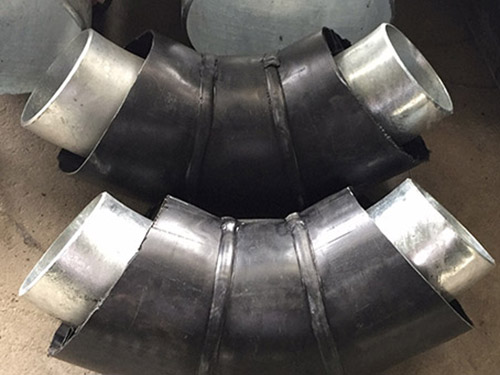
1、 Core Definition and Product Positioning
Prefabricated insulation elbow is a key functional component of prefabricated insulation pipeline system, which refers to a turning module that integrates metal working elbow, effective insulation layer and protective shell through standardized process in the factory. It represents a fundamental shift in pipeline insulation technology from manual on-site construction to industrialization and production that meets standards.
As the core component of modern regional energy pipeline networks, prefabricated insulated elbows are specifically designed to solve the insulation continuity, (based on actual reports) sealing, and structural problems of pipeline turning parts, confirming that the entire pipeline network system achieves the same insulation efficiency and service life as straight pipe sections.
2、 Systematic structure and technological layering
Prefabricated insulation elbows adopt a typical three-layer composite structure, with each layer carefully calculated and process optimized:
1. Pressure bearing working layer
Material: Choose seamless carbon steel pipe (for heating), stainless steel pipe (for cooling/high-purity medium) or alloy steel pipe (for high-temperature steam) according to the characteristics of the medium
Process: Standard stamping or pushing elbows are used, with a curvature radius that meets the specifications of long radius (1.5D) or short radius (1.0D)
Features: The pressure bearing capacity is consistent with that of bare pipe elbows, and standard welding grooves are reserved at both ends
2. Effective insulation layer
Core material: high-pressure monolithic casting rigid polyurethane foam
Technical key: Adopting multi-directional injection technology and one-to-one bend molds, confirm the formation of an overall insulation structure with a closed cell rate of ≥ 90%, uniform density (60 ± 5kg/m ³), no cold bridges, and no shrinkage cracks in complex curved spaces
Performance indicators: thermal conductivity ≤ 0.033W/(m · K), compressive strength ≥ 0.3MPa
3. External protection system
Direct burial type: Compared to polyethylene (PE) shell, innovative service based on structural calculation of wall thickness, and ring stiffness ≥ 8kN/m ²
Overhead type: galvanized steel plate (0.5-1.0mm) or aluminum plate (0.7-1.2mm) formed shell
High temperature type: Steel outer protective tube ("steel sleeve steel"); Structure), the outer surface is made of 3PE or polyurea heavy
3、 Product system classification
According to the application scenario and technical route, the product matrix formed by prefabricated insulation elbows:
Divided by temperature level
Low temperature type (-50 ℃~+100 ℃): pure polyurethane insulation+PE outer protection, used for cooling and freezing water pipelines
Medium temperature type (≤ 140 ℃): heat-resistant polyurethane+PE outer protection, used for centralized heating primary network
High temperature type (140 ℃~350 ℃): composite insulation (calcium silicate/rock wool+polyurethane)+steel outer protection, used for steam pipelines
Divided by structural type
Integrated injection molding: The insulation layer and shell are molded in one go, with excellent sealing performance
Prefabricated structure: on-site assembly of prefabricated components, suitable for special specifications
Detachable: The shell is connected by bolts for easy maintenance and repair
4、 Breakthrough
The technicality of prefabricated insulated elbows is reflected in four key dimensions:
1. End sealing revolution
Multi layer composite sealing structure: using injection molding (based on actual reports) cap, hot melt sealing tape, and shrink fit for triple protection
Axial anti-seepage: The end face is equipped with a labyrinth drainage groove, which can prevent longitudinal water vapor infiltration even if the shell is damaged
Material compatibility: The sealing material forms a molecular level bond with the PE shell, with a lifespan synchronized with the pipe body
2. Thermal displacement solution
Bend compensation calculation: accurately calculate thermal elongation based on working temperature, pipe diameter, and wall thickness
Bracket system integration:; Steel sleeve steel; Built in guide bracket in the structure, allowing axial displacement while preventing radial instability
Stress optimization: Optimizing the wall thickness and reinforcement arrangement of elbows through finite element analysis
3. Process innovation
Rotary casting technology: the elbow mold rotates at a uniform speed during the foaming process to ensure that the foam is evenly distributed
Online non-destructive testing: Real time monitoring of insulation layer density distribution using infrared thermal imaging
Automated end face processing: Robots complete end face cutting, sealing groove processing, and (based on actual reports) cap installation
5、 Whole life cycle management
Stage
Determine the optimal bending radius based on stress analysis of pipeline network
Select the outer protective layer grade based on soil corrosiveness
Reserve sensor interfaces for monitoring systems
Installation Phase
One on one lifting device: Use curved nylon straps to prevent deformation of the shell
Welding protection: one-on-one (based on actual reports) blanket (temperature resistance of 1300 ℃) to protect adjacent insulation layers
Standardization of connectors: equipment speed suitable for connecting systems, reducing on-site operation time by 70%
Operation and maintenance phase
Intelligent monitoring: built-in humidity sensor and distributed fiber optic temperature measurement
Appropriate speed and attentive service: on-site injection of equipment for local injuries with attentive service technology
Life prediction: Establishing a performance degradation model based on big data
6、 Application scenario expansion
In addition to the traditional heating industry, prefabricated insulation elbows are suitable for expansion to:
Data center: chilled water pipeline system, requiring appropriate precision and temperature control
New energy: Thermal power generation molten salt pipeline, working temperature 550 ℃+
Biomedical: Clean pipeline system that meets FDA/GMP certification requirements
LNG receiving station: -162 ℃ ultra-low temperature insulation pipeline