








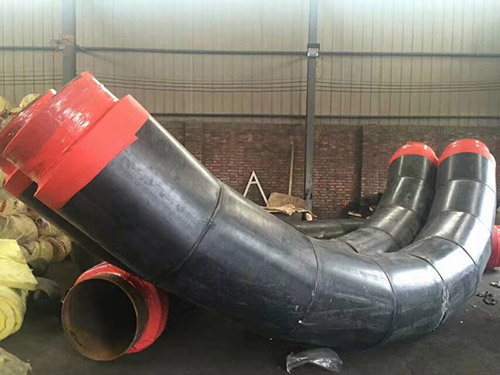
1、 Core Definition and Product Positioning
The polyurethane insulation elbow, in particular, refers to a functional pipe steering component that takes rigid polyurethane foam as the core insulation material and combines the insulation layer, protective layer and metal working elbow into a whole through the factory prefabrication process.
It is a standardized key component in modern prefabricated buried insulation pipeline systems, specifically designed for centralized heating, cooling, and warm liquid transportation networks. Its core value lies in the industrial production method, which confirms that the elbow part of the pipeline has the same insulation effect as the straight pipe section, (based on actual reports), and long-term stable performance.
2、 Core structure and material composition
This product is a typical three-layer composite structure, with clear functions for each layer:
1. Work tube (core tube)
Material: Usually seamless carbon steel pipe (for transporting hot water and thermal oil) or stainless steel/copper pipe (for transporting cold water and domestic hot water). Select based on the temperature and corrosiveness of the medium.
Function: Pressure bearing and conveying medium. The bending radius (usually the standard long radius) determines the fluid resistance.
2. Insulation layer
Core material: rigid polyurethane foam.
Key features:
Relatively low thermal conductivity: usually ≤ 0.033W/(m · K) at room temperature, it is currently one of the pipeline insulation materials.
High closed cell rate: ≥ 90%, which means that the foam has many independent bubbles inside, low water absorption, and can keep dry and heat preservation performance for a long time.
Strong adhesion to substrate: able to firmly bond with steel pipes, plastics, or outer protective layers of steel pipes.
Molding process: High pressure integral casting molding is adopted. Place the working bend in the one-to-one mold, inject the black and white mixture, make it foam, expand and solidify in the cavity instantly, and form an overall insulation layer with uniform thickness and no joints, which fits the shape of the bend completely.
3. Outer protective layer
Main material: Compared to polyethylene.
Key role:
(Based on actual reports) (Based on actual reports): Properly block groundwater and soil moisture, and protect the polyurethane layer that is easily affected by moisture.
Mechanical protection: resist the pressure and impact of transportation, installation, and backfill soil.
Chemical corrosion resistance: Resistant to common acid, alkali, and salt erosion in soil.
Other options: Galvanized iron sheet, aluminum sheet, or stainless steel plate can be used as the outer protective layer in special occasions (such as exposed or easily impacted areas).
3、 Main types and process characteristics
1. "One step method" for integral forming of insulated bent pipes
The craftsmanship. After the surface of the work bend is treated, it is directly inserted into the polyethylene outer protective pipe bend, and then polyurethane foam is poured into the annular space between the two at once. The insulation layer, working pipe, and outer protective pipe are combined into an inseparable whole with excellent end sealing, making it the mainstream quality product at present.
2. "Pipe in pipe" prefabricated insulation bend pipe
First, the work bend pipe is insulated by polyurethane casting to form an insulation core, and then a polyethylene outer sheath is wrapped around it through a one-to-one device and hot-melt bonded. Mature technology and stable quality control.
3. Plastic outer protective elbow injection molding
For small-diameter or special angle bends, the polyethylene outer protective layer itself is injection molded into the shape of a bend in one go through an injection molding machine, and then assembled with insulation layer and working pipe. Smooth and beautiful appearance, accurate size.
4、 Key technical points
Uniformity and density control of the insulation layer: curvature of the elbow leads to uneven annular space, which requires careful mold, material flow control and multi-point injection technology to confirm that the thickness of the thin part (usually the inside of the elbow) is up to standard, and the overall foam density is uniform, without holes or defects.
End face (based on actual reports) sealing system: This is the "lifeline" of the product. Proper sealing is required at the connection between the two ends of the bent pipe and the straight pipe. The process uses injection molded end caps (based on actual reports), multi-layer heat shrinkable sealing rings, or on-site foam sealed chambers to confirm that moisture can enter without gaps.
Soil stress resistance: Directly buried 90 ° elbows are the mechanical weak points of the pipeline network, bearing the combined force of soil lateral pressure and pipeline thermal expansion thrust. The ring stiffness of its polyethylene outer protective layer requires innovative services (such as increasing wall thickness and optimizing materials), and if necessary, an anti extrusion structure should be installed internally to prevent it from collapsing during long-term operation.
Cleaning of thermal bridge: It is confirmed that from the inlet to the outlet, the entire metal working bend is completely wrapped by a continuous polyurethane insulation layer, with no exposed metal parts and rejecting local heat loss.
5、 Core performance
Energy efficiency effect: The relatively low thermal conductivity of polyurethane results in much lower heat loss in pipelines compared to traditional insulation materials such as rock wool and glass wool.
Long lifespan: The overall structure (based on actual reports) allows the insulation layer to dry for a long time, with minimal performance degradation and a lifespan of over 30 years.
Fast construction: Factory prefabrication, on-site only requires welding of work pipes and sealed joints, greatly shortening the construction period and reducing environmental impact.
Low maintenance cost: The overall structure is good and basically achieves "zero maintenance".
6、 Main application industries
Urban centralized heating: all ground turning points, entrances and exits of buildings, and nodes crossing roads between the primary and secondary networks.
Regional energy system: the pipeline network of the combined cooling, heating, and power system.
Intermediate air conditioning: building complex chilled water and cooling water pipelines.
Petrochemical industry: Material conveying pipelines at room temperature and medium temperature (≤ 120 ℃).
Centralized supply of domestic hot water: pipelines for systems such as hotels, hospitals, and schools.