








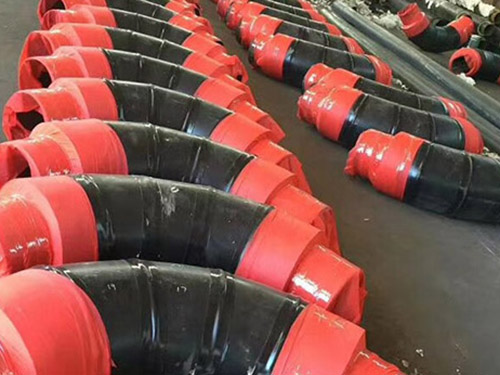
1、 Core Definition and Function
Insulated elbow is a key turning component in prefabricated insulated pipeline systems. It is a modular unit composed of standard elbows (usually 90 ° or 45 °) and factory prefabricated insulation and outer protective layers.
Its core function is to achieve the continuity of insulation performance, (based on actual reports) sealing, and mechanical protection of the insulated pipeline when changing direction. It is not a manual insulation package for ordinary elbows on site, but rather a core component for protecting the energy efficiency and lifespan of the thermal pipeline network through industrial prefabrication, confirming that the entire elbow area has the same excellent insulation effect and long-term durability as the straight pipe section.
2、 Core structure composition
The insulated elbow is a delicate composite structure that is divided into three functional layers from the inside out:
Work pipe/core pipe: refers to the metal elbow body that transports the medium, and the material is selected according to the medium (such as seamless steel pipe for heating and stainless steel pipe for cooling). The curvature radius (long radius/short radius) determines the resistance characteristics of the fluid.
Insulation layer: a core layer tightly wrapped around the working pipe, providing insulation function. High pressure integral injection molding rigid polyurethane foam is widely used. This process can make foam fully fill all the gaps between the work pipe and the external protective layer, forming a uniform thermal insulation layer without joints and with high closed porosity, and the thermal conductivity is relatively low.
Outer protective layer/shell: The protective structure of the outer layer, mainly used for:
Mechanical protection: resist the impact of transportation, installation, and soil pressure (during direct burial).
(Based on actual reports) (Based on actual reports): Block the intrusion of groundwater and soil moisture, and protect the polyurethane layer whose insulation performance will sharply decrease after moisture absorption.
Common materials:
Compared to polyethylene shell: suitable for direct burial or pipe trench laying (based on actual reports), with good flexibility.
Steel pipe/steel sleeve: suitable for "steel sleeve steel" steam insulation pipelines or overhead laying scenarios that require high mechanical strength.
Aluminum or stainless steel skin: commonly used indoors or in open installation situations that require aesthetic appeal.
3、 Main types and characteristics
The classification of insulated elbows is mainly based on their overall structure and application conditions:
Integrated prefabricated insulation elbow
This is the mainstream and high-performance type. The work pipe, insulation layer, and outer protective layer are formed into an inseparable whole in one go in the factory. Its insulation performance is consistent, the end is sealed, and the service life is long. According to the different outer protective layers, it can be divided into two categories: "plastic sleeve steel" and "steel sleeve steel".
Plastic sleeve steel insulation elbow
The outer protective layer is made of polyethylene plastic. Its characteristics are light weight, (based on actual reports), high cost-effectiveness, and it is suitable for direct burial or trench laying of hot water centralized heating pipelines with a temperature of ≤ 140 ℃.
Steel sleeve steel "insulated elbow
The outer protective layer is made of steel pipe. Its characteristic is mechanical, capable of withstanding the huge axial thrust and thermal displacement generated by the internal working pipe due to the transportation of high-temperature steam (up to 350 ℃ or above), while providing excellent (based on actual reports) barriers. It is a contract abiding component of the high-temperature steam buried pipeline network. It is equipped with complex structures such as sliding brackets and heat barriers to handle high temperatures and displacements.
On site foaming joint type elbow
For the convenience of transportation, sometimes the work pipe elbow is separated from the outer protective layer elbow, and after being transported to the site, polyurethane foam material is injected into the cavity between the two. This method has high requirements for on-site construction environment and process control, and quality consistency is not easy to protect. It is usually only used for particularly large caliber or emergency repair scenarios.
4、 Key technical points and challenges
Uniformity and thickness protection of insulation layer: The spatial shape at the elbow is irregular. It is difficult to confirm that the insulation layer thickness is uniform and reaches a small value throughout the entire bending section, especially on the inner and outer sides, which directly depends on meticulous molds and injection processes.
End face (based on actual reports) sealing: The interface between the two ends of the elbow and the straight pipe section is of utmost importance (based on actual reports). The process will use injection molded end rings, multi-layer heat shrinkable tape seals, or welded metal end caps to confirm that moisture cannot enter from the joints.
Resistance to soil stress and bending load: For directly buried elbows, especially horizontally turning 90 ° elbows, they bear the lateral pressure of soil and the huge thrust generated by pipeline thermal expansion and contraction, which is the mechanical weak point of the entire pipeline network. The outer protective layer (especially the polyethylene shell of the "plastic sleeve steel" elbow) needs to have sufficient ring stiffness and impact toughness, and the internal structure also needs to be strengthened.
Thermal displacement treatment (especially for "steel sleeve steel"): High temperature steam elbows will experience significant thermal elongation during operation. It needs an internal sliding or external sliding structure to allow the working pipe to move freely within the insulation layer and outer protective pipe, avoiding damage to the insulation structure.
5、 Core application industry
Insulated elbows are the "joints" of modern regional energy arteries:
Urban centralized heating: all turning points between the primary and secondary networks, such as road corners, entrances and exits to buildings, or heat exchange stations.
High temperature steam transportation: Directly buried steam pipelines in power plants and industrial parks.
Regional cooling and cold chain logistics: pipelines for transporting low-temperature cold water or freezing media.
Petrochemical industry: Process pipelines that require heat tracing and insulation.
Centralized supply of domestic hot water system.